



There is rarely one clear moment when an adult child realizes a parent may need more help.
It may begin with a missed appointment, a confusing medical bill, an unusual withdrawal, or a question about an account the parent has managed for years. The parent may still sound like themselves, but something feels less certain than it once did.
Most families do not wake up one morning and decide the roles have changed. They notice small signs, then more of them. Eventually, concern begins to feel like responsibility.
That is often when the most difficult question surfaces: How do you step in without taking over?
A 2026 report found that 27% of Americans had never discussed end-of-life wishes with their families and had no plans to do so. Another 42% said they would not know what to do if a family member died that day, highlighting how many families reach a difficult transition without a clear plan or established communication framework.¹
Financial professionals often see how challenging this period can be. A thoughtful approach begins with recognizing the signs, opening the conversation early, and putting the right legal, financial, and healthcare structures in place while a parent can still participate fully.
Why Families Delay the Conversation
Conversations about aging, money, healthcare, and independence can feel uncomfortable for everyone involved.
Behavioral finance offers one explanation. Researchers sometimes refer to the tendency to avoid threatening or emotionally difficult information as the ostrich effect. When we believe a conversation may force us to confront something painful or act before we feel ready, it can be easier to postpone it.²
Discussions about an aging parent’s financial life often fall into this category.
Adult children may hope their parents have everything organized. Parents may worry that raising the subject will make them appear less capable or independent. Both sides may understand that the conversation is important, yet neither wants to be the person who starts it.
Earlier engagement is valuable not only because it creates more time to organize documents and accounts, but also because it gives parents a greater opportunity to express their preferences directly.
When families wait until a hospitalization, cognitive decline, or financial emergency, decisions may need to be made quickly and with incomplete information. When they begin while everyone is healthy and engaged, the process can remain collaborative.

How to Begin Without Making It Feel Like a Takeover
The way the conversation is framed often matters more than the amount of information covered.
Opening with concerns about a parent’s ability to manage their affairs can sound like criticism, even when the intention is supportive. A more effective starting point may be to focus on the adult child’s need to understand what to do in an emergency.
For example:
“I realized I would not know whom to call or where to find the important documents if something happened. Could we go through that together?”
This changes the focus from capability to preparedness.
It may also help to keep the first conversation narrow. Rather than asking to review every financial account, begin with one practical question:
- Where are the estate documents kept?
- Who is the attorney?
- Is there a durable power of attorney?
- Which healthcare documents are in place?
- Who should be contacted in an emergency?
- Is there a current list of accounts and insurance policies?
The goal is not to resolve everything in one meeting. It is to open the door.
For some families, having a financial professional or attorney help facilitate the conversation can reduce tension. A neutral third party may help keep the discussion focused on preparation rather than whether a parent is still capable of managing independently.
Legal and Healthcare Documents Families Should Understand
The right documents can allow trusted individuals to help when needed. Without them, even a close family member may have limited authority to act.
Durable Power of Attorney
A power of attorney authorizes another person to manage certain financial or legal matters on someone’s behalf.
The word durable is important. A durable power of attorney generally remains effective if the person who created it later becomes incapacitated. A non-durable power of attorney may terminate when capacity is lost.³
Families should also understand when the authority becomes effective.
Some powers of attorney are effective immediately, while others are “springing,” meaning they become active only after a formal determination of incapacity. Although that structure may feel more protective, it can also create delays when a family needs to act quickly.
The appropriate design depends on the family’s circumstances and should be reviewed with a qualified estate-planning attorney.
Healthcare Proxy
A healthcare proxy, sometimes called a healthcare power of attorney, identifies the person authorized to make medical decisions when an individual cannot make or communicate those decisions independently.³
This document is especially important because financial authority does not automatically include healthcare decision-making authority.
Advance Directive
An advance directive records a person’s preferences regarding medical treatment and end-of-life care.
It may address matters such as life-sustaining treatment, resuscitation, ventilation, artificial nutrition, or comfort care. The objective is to provide guidance when the individual cannot speak for themselves.
POLST
A POLST—Physician Orders for Life-Sustaining Treatment—is different from a general advance directive.
It is a medical order signed by a physician or other authorized healthcare professional and is generally intended for people with serious illnesses, advanced frailty, or significant medical needs. Because it is a medical order, it may guide treatment immediately in an emergency or clinical setting.⁴
Families should discuss whether a POLST is appropriate with the individual’s physician and legal advisors.
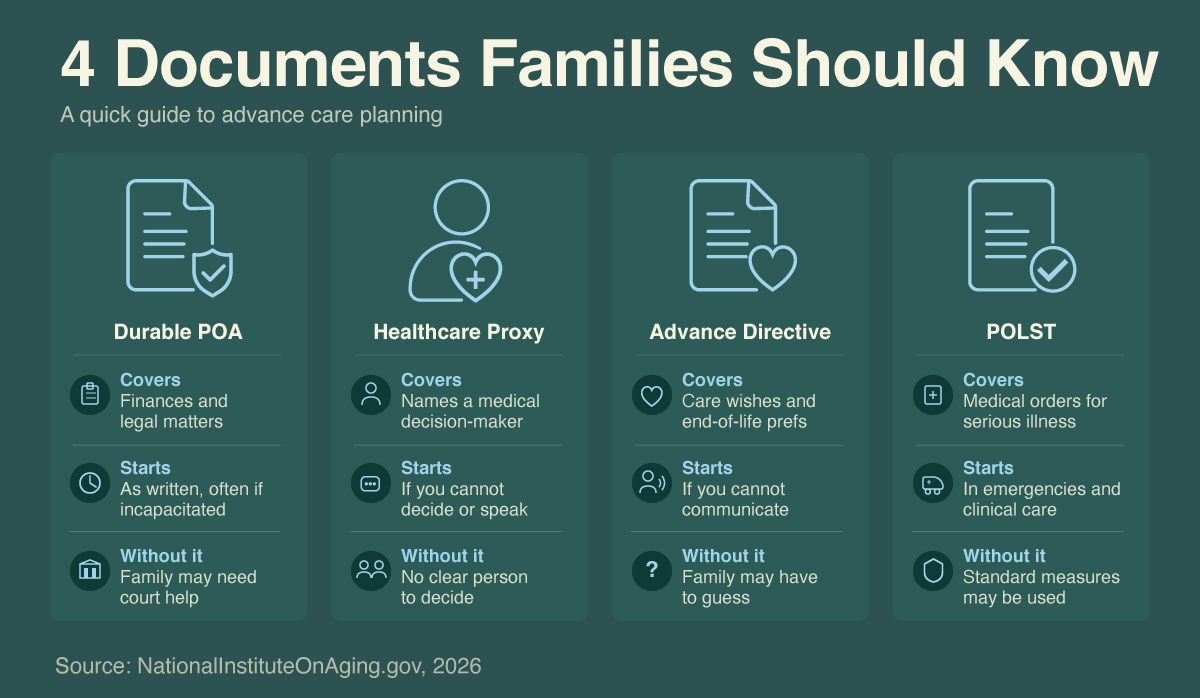
Without suitable documents in place, a family may need to seek guardianship or conservatorship through the courts before making financial or medical decisions. That process can be costly, time-consuming, and emotionally difficult.
Advance planning cannot prevent every complication, but it may reduce the likelihood that a family has to navigate a legal process during a crisis.
Organizing the Full Financial Picture
Even when the right conversations have taken place and legal documents are complete, many families still lack a clear picture of a parent’s financial life.
Important details may be spread across paper files, online accounts, email inboxes, safe-deposit boxes, and several professional relationships.
A family financial inventory can bring those details together in one organized record.
The inventory may include:
- Bank and investment accounts
- Retirement plans and pension income
- Real estate and business interests
- Insurance policies
- Monthly bills and automatic payments
- Loans and other liabilities
- Estate documents and their locations
- The names of attorneys, accountants, advisors, and insurance professionals
- Beneficiary information
- Digital accounts and access instructions
- Emergency contacts
Passwords and sensitive account credentials should be stored securely rather than placed in an ordinary spreadsheet or unsecured document.
Families should also consider how a trusted person would gain access if the parent became incapacitated. Merely knowing that an account exists may not be enough if access procedures, legal authority, or recovery information are missing.
Research suggests that aspects of financial decision-making can begin to change before a formal diagnosis of cognitive impairment. That makes early visibility and organization not merely convenient, but potentially protective.⁵
Financial Exploitation Is Often Closer Than Families Expect
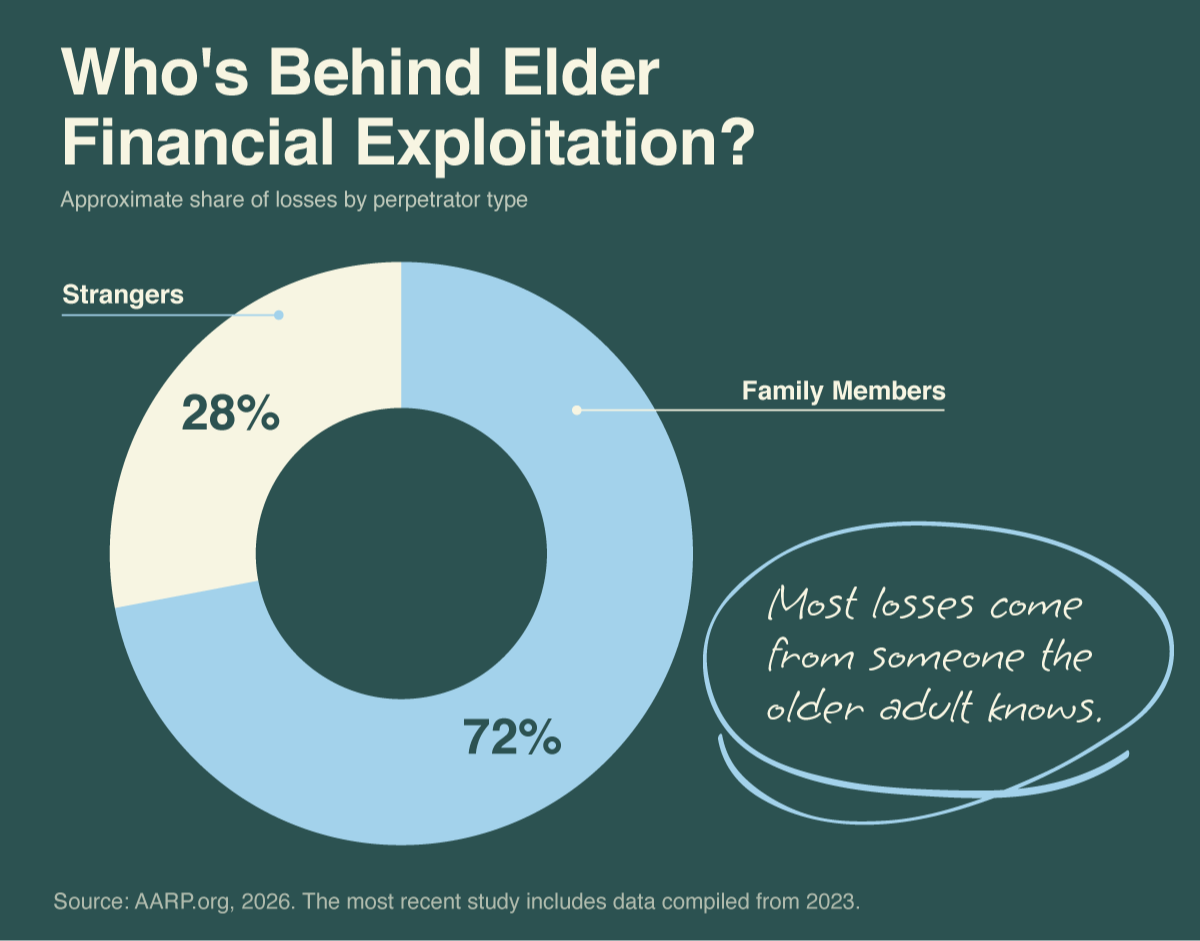
Elder financial exploitation is one of the most serious risks facing older adults, and many incidents are never formally reported.
According to research cited by AARP, approximately 72% of elder financial exploitation losses—about $20.3 billion of an estimated $28.3 billion total—were linked to known perpetrators, including family members, caregivers, and others with trusted access.⁶
That finding can be uncomfortable, but it is important.
Families often focus on strangers, fraudulent calls, phishing emails, and online scams. Those threats are real, but access and familiarity can also create risk.
Warning signs may include:
- Unusual withdrawals or transfers
- New names added to financial accounts
- Sudden beneficiary changes
- Changes to a will or trust
- Unpaid bills despite adequate resources
- Large gifts that appear inconsistent with prior behavior
- A new caregiver or acquaintance exerting influence
- Increased secrecy around finances
- Confusion about routine transactions
- Missing valuables or documents
A constructive approach is to establish structure rather than surveillance.
That may include account alerts, duplicate statements, a trusted contact on financial accounts, periodic review meetings, and clear separation of duties when more than one family member is involved.
For families with substantial assets, the stakes may be higher simply because there is more to lose. The objective is not to assume wrongdoing. It is to create enough transparency and accountability that unusual activity can be identified and reviewed promptly.
What Medicare Covers—and What It Does Not
Healthcare costs often become one of the most difficult parts of planning for aging parents.
Medicare may cover certain short-term skilled nursing facility services following a qualifying hospital stay, but it generally does not cover ongoing custodial care simply because someone needs help with activities such as bathing, dressing, eating, or managing medications.
Under the rules cited in the original research, Medicare may fully cover the first 20 days of qualifying skilled nursing care, followed by a daily copayment of $217 from days 21 through 100. Coverage generally ends after day 100.⁷
The distinction between skilled care and custodial care is important. Many families assume Medicare will pay for an extended stay in assisted living or a nursing home, only to discover that long-term support is outside the scope of standard coverage.
Research also suggests that approximately 70% of Americans age 65 and older will need some form of extended care during their lifetime.⁷,⁸
Medicaid may cover certain long-term care expenses, but it is means-tested and subject to financial eligibility requirements. Families with meaningful assets may not qualify without spending down resources or engaging in advance legal and financial planning.
For those families, the primary planning approaches may include:
- Self-funding future care expenses
- Long-term care insurance
- Hybrid life insurance or annuity products with extended-care benefits
- Family caregiving arrangements
- A coordinated combination of personal assets, insurance, and family support
Each option involves tradeoffs related to cost, liquidity, flexibility, underwriting, and control. The appropriate strategy depends on the family’s resources, health, estate objectives, and willingness to retain or transfer the risk.
A Practical Family Preparation Framework
Families do not need to solve every issue at once. A more manageable approach is to work through the planning in stages.
1. Begin the conversation
Choose a calm time when no immediate crisis is underway. Frame the discussion around preparedness, not control.
2. Identify the decision-makers
Confirm who would manage financial matters, who would make healthcare decisions, and who should be contacted first in an emergency.
3. Review the legal documents
Ask an estate-planning attorney to review powers of attorney, healthcare documents, wills, trusts, and beneficiary designations. A financial advisor may help support estate and legacy strategy coordination across the broader financial plan.
4. Build the financial inventory
Create an organized record of accounts, policies, income sources, liabilities, recurring payments, professional contacts, and document locations.
5. Establish appropriate visibility
Consider account alerts, trusted-contact designations, duplicate statements, and periodic family reviews.
6. Evaluate extended-care risk
Estimate the potential cost of care and review how it would be funded without unnecessarily disrupting retirement income planning or the broader financial plan.
7. Revisit the plan periodically
Health, family roles, laws, accounts, and preferences change. The plan should be reviewed rather than filed away indefinitely.
How OakStreet May Help
A financial advisor does not replace an estate-planning attorney, physician, tax professional, or long-term care specialist.
An advisor may, however, help families organize the financial picture, model potential care costs, review the effect of those costs on the portfolio, coordinate with legal and tax professionals, and facilitate conversations that might otherwise be difficult to begin.
The families who tend to feel most prepared are often those who treat this transition as a planning process rather than a response to a crisis.
Preparation does not eliminate the emotional difficulty of changing family roles. It can, however, give parents a stronger voice in their own future and give adult children clearer guidance when help is eventually needed.
Frequently Asked Questions
When should families begin discussing these issues with their parents?
There is no universal age.
The best time is generally while parents remain healthy, engaged, and able to express their wishes clearly. For many families, that may mean beginning in a parent’s 60s or early 70s, but health, family circumstances, business interests, and financial complexity may justify starting earlier.
The objective is not to intervene prematurely. It is to become organized before the family is forced to act quickly.
What is the difference between a durable power of attorney and a regular power of attorney?
A durable power of attorney generally remains effective if the person who created it becomes incapacitated. A non-durable power of attorney may terminate when capacity is lost.³
Families should also determine whether the document is effective immediately or only after a formal finding of incapacity. An estate-planning attorney can explain how the document operates under applicable state law.
Who is most likely to commit elder financial exploitation?
Research indicates that a substantial portion of losses involves people the older adult knows rather than strangers. This may include relatives, caregivers, friends, or others with trusted access.⁶
Protective planning should therefore include both external fraud prevention and internal accountability.
Does Medicare pay for long-term nursing-home or assisted-living care?
Generally, Medicare does not cover long-term custodial care. It may cover qualifying short-term skilled nursing services under specific conditions and for a limited period.⁷
Families should review likely extended-care costs separately from ordinary Medicare planning.
How can an adult child help without making a parent feel controlled?
Begin with shared preparation rather than a request to take over.
Ask where documents are located, whom to call in an emergency, and what the parent would want if assistance became necessary. Keep the first conversation limited and practical. Parents are more likely to remain engaged when the process respects their independence and gives them an active role in the decisions.
1 TrustandWill.com, 2026
2 TheDecisionLab.com, 2026
3 www.nia.nih.gov, 2026
4 Connellylaw.com, 2026
5 pmc.ncbi.nlm.nih.gov, 2026
6 AARP.org, 2026
7 Medicare.gov, 2026
8 JRCInsuranceGroup.com, 2026